Pollinators of Handrkov
Welcome to the field research page for the Handrkov meadow! Here you will find all relevant information regarding our research, contacts, and practical information for organizing this year’s event.
Mission and Goals
The goal of the pollinator research at Handrkov is to investigate the relationships between plants, their pollinators, and pollinator parasites. A series of experiments helps us with this, some of which have been running since 2011. The long-term goal is to determine how stable these relationships are and what can influence them on such an ordinary meadow.
Another goal of the whole event is to enable people interested in field research to meet, learn how research works, and connect with a wider group of people who share these interests. We aim to create an environment that inspires and generates enthusiasm. We hope we are succeeding.
Practical Information
Summary
- 📍 Where: Handrkov (49.8463442N, 15.1504281E) near the village of Vernýřov
- 📅 When: From August 10th to August 25th, 2026, with the “hot phase” from August 15th to August 25th.
- 👥 Who: Anyone interested in joining pollinator research is welcome! We will teach you everything!
- 🍎 Food: We cook together; food is provided for vegetarians and vegans as well. Having your own water bottle and mess kit is an advantage.
- 🚗 Transport: We will provide transport from Uhlířské Janovice or Zbraslavice. Write to +420 774 553 734
- ⛺ Accommodation: Under a tarp, or in your own tents.
- ✉️ Contact: Jakub Štenc
- Join us: For easier organization, please sign up in the spreadsheet. Also add dietary restrictions for the food shopping plan.
Pollinator research at the Handrkov meadow will take place from August 10th to August 25th, with a “hot phase” approximately from August 15th to August 25th. You can participate for any length of time, but it is better for us to know about your participation in advance. Therefore, please add your name to this spreadsheet (it should be editable; if not, let us know). The table is not binding, and you can certainly fill in “maybe”. However, we are mainly interested in getting an overview regarding the potential deployment of human resources for various experiments, and also for food shopping and water provision. And please also add a note about dietary restrictions.
We will be studying interactions between insects and plants at the Handrkov meadow (49.8463442N, 15.1504281E) near the village of Vernýřov through a series of experiments, some of which have been running for the thirteenth year. We provide food and transport from the nearest town (Uhlířské Janovice or Zbraslavice, depending on the direction of arrival). We live directly on the meadow under a large tarp, cook together on a fire, and a novelty of recent years is a small solar shower with a screen. Although the conditions are slightly Spartan, it makes for a better experience (and allows us to conduct experiments from morning to evening without the need to commute).
We appreciate any help and we will teach you everything necessary! You only need to bring clothes, something for your head (sunstroke is the most common problem), your own water bottle (we provide water centrally, but it’s good to have one bottle for personal consumption), and things for sleeping outside (it can get slightly chilly from the pond sometimes, so it’s better to be prepared). Generally, we also bring some forks and bowls for food, but for increased “competitive ability,” I recommend bringing your own fork/spoon, knife, and bowl - sometimes there are more of us than forks, and it’s harder to compete (but there is rarely hunger).
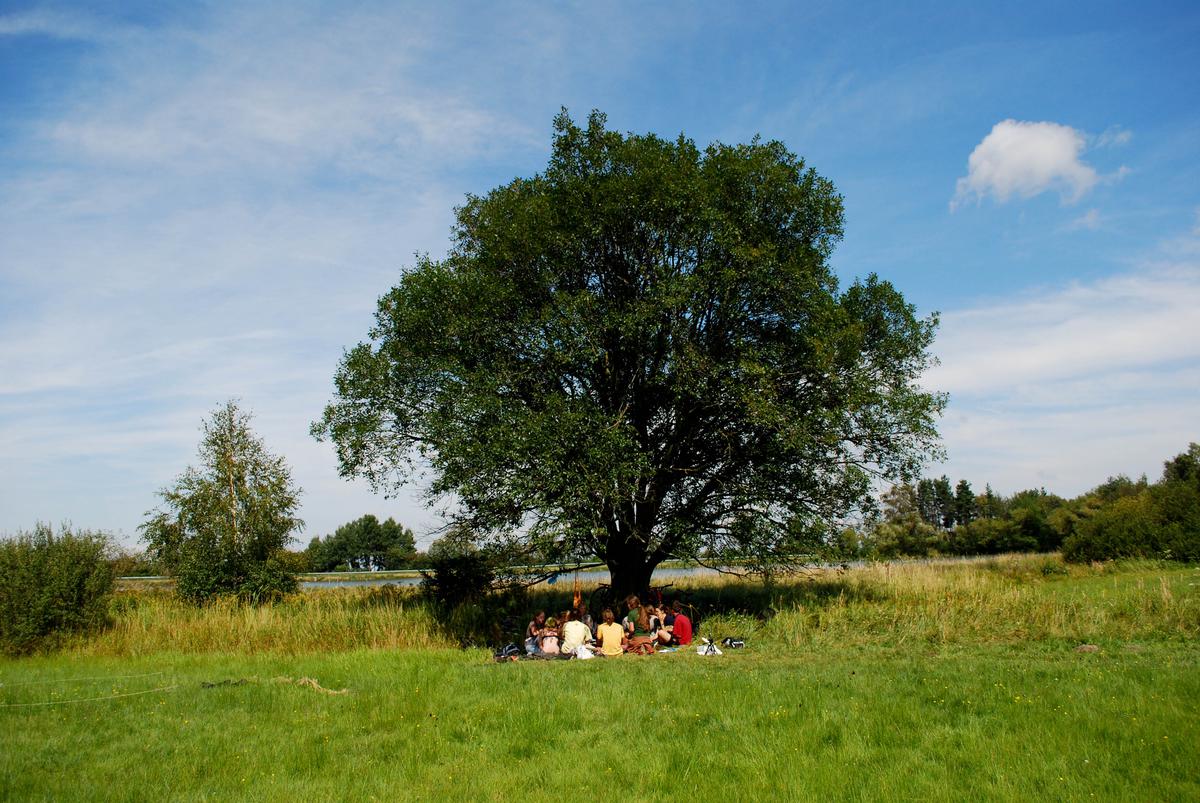
Join Us!
Really anyone of good will can join! No previous knowledge of plants or animals is required; we will teach you everything necessary. You just need to count on sleeping outside/in a tent and long-term exposure to the sun.
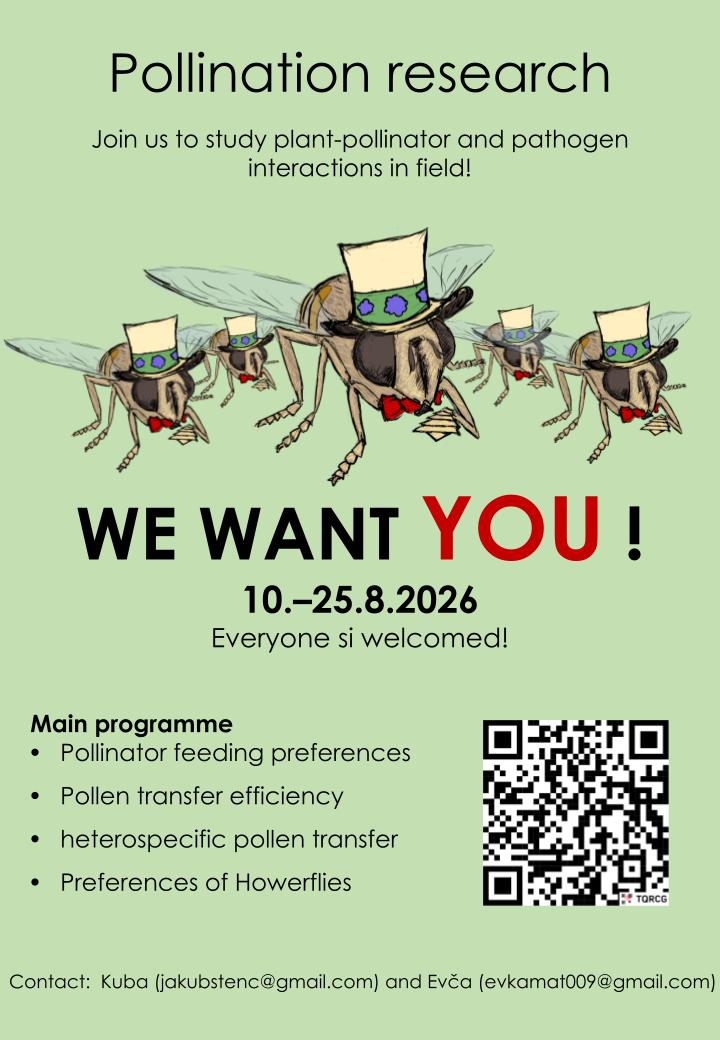
Poster
Gallery
Contact
- 📧 E-mail: Jakub Štenc
- 📞 Phone: Jakub Štenc
- 💬 WhatsApp: Jakub Štenc
- 📸 Instagram: opylovaci_handrkov_
- 📘 Facebook: Opylovači
- 🎙️ Podcast: Spotify, YouTube
Information on Experiments:
This year we plan a series of experiments, with the main experiment “Other Squares” consisting of observing interactions in a system of approx. 96 permanent plots measuring 4*4 meters. Furthermore, we will collect stigmas from plants, on which we will then determine deposited pollen grains in the laboratory, because we are interested in which species unwanted pollen transfer occurs between. Then we will investigate how much pollen pollinators carry away and bring to the stigma in one visit, and how much pollen they carry on their bodies. In another experiment, we will continue collecting data regarding the decision-making of pollinators when choosing which flower they prefer to fly to (we call the experiment “Forks”, it is a paired decision test). Newly, we will try to look for trypanosomes in the guts of hoverflies (under the leadership of Šimon Zeman) and somewhat old/newly we will do experiments with artificial flowers in experimental cages (but this is still slightly uncertain). Furthermore, we want to try a methodology for observing nocturnal pollinators this year, both by shining light on a screen and by walking around the meadow with a red headlamp. We will see how it works out!
Other Squares (Jiné čtverce)
“Other Squares” is an experiment that has been running since 2011 and allows us to view changes in relationships between pollinators and plants between years. 96 permanent plots of 4*4 meters, placed on the meadow in a regular grid, serve this purpose.
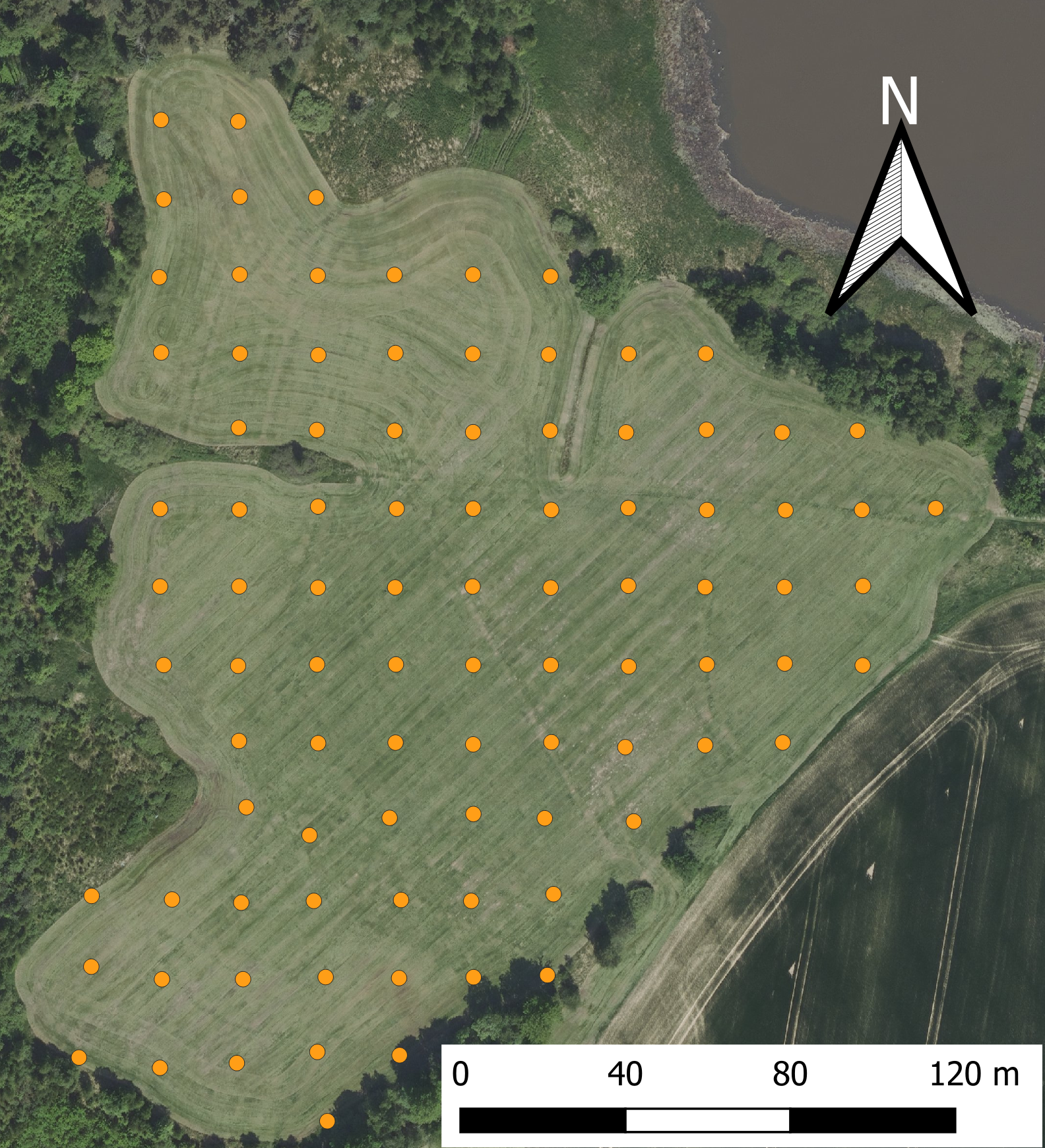
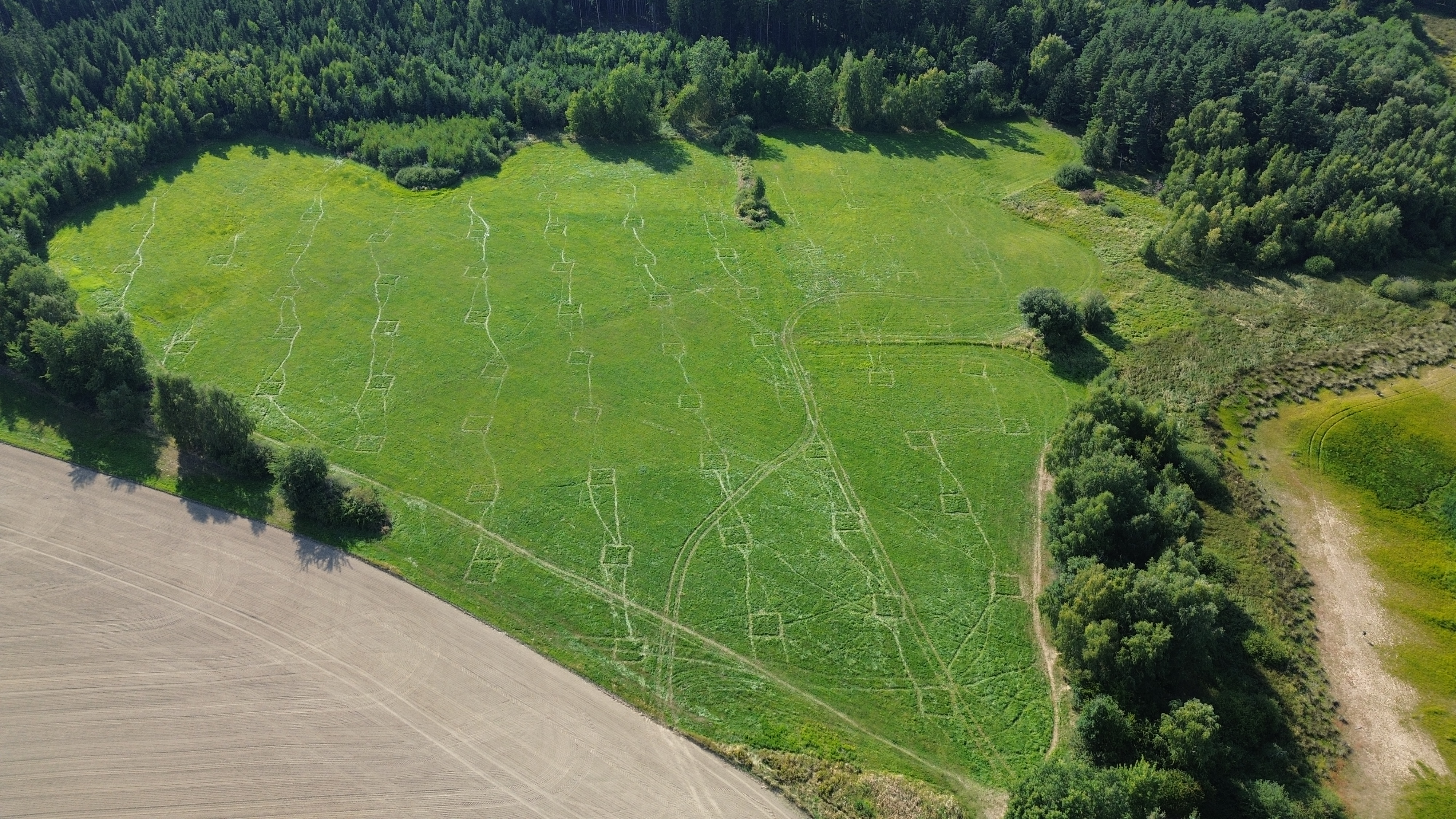
Each square is permanently marked and must be found every year using a metal detector. Then we count the number of flowering plants in them and record interactions with their pollinators.
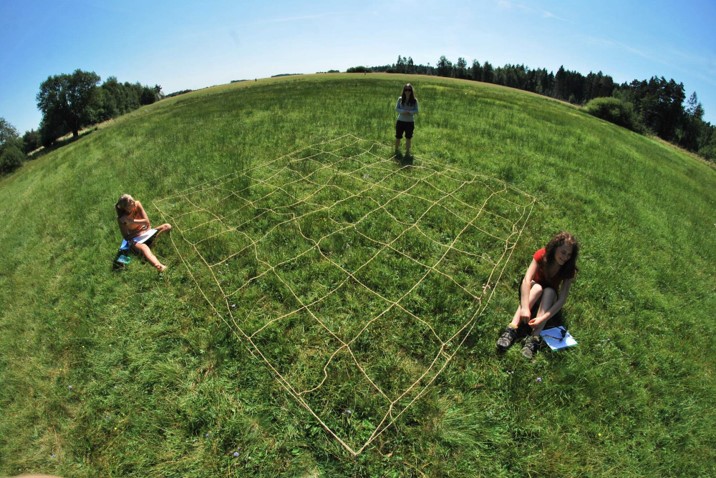
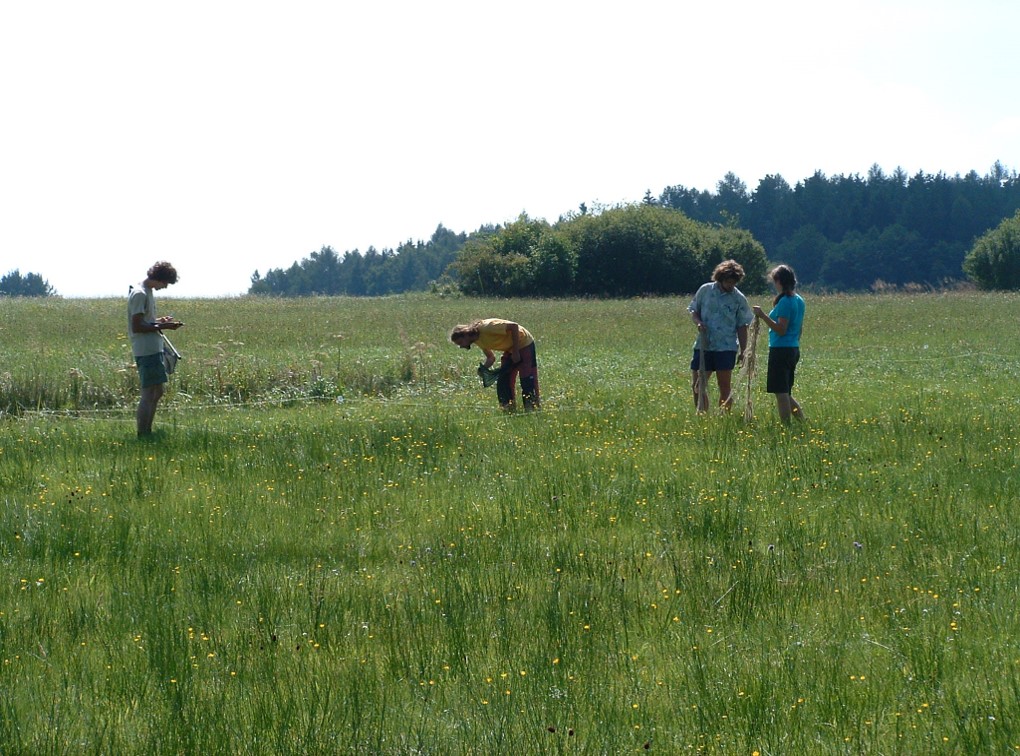
In the result, we see the network of relationships between plants and pollinators and see its transformations between individual years.
Stigmas (Blizny)
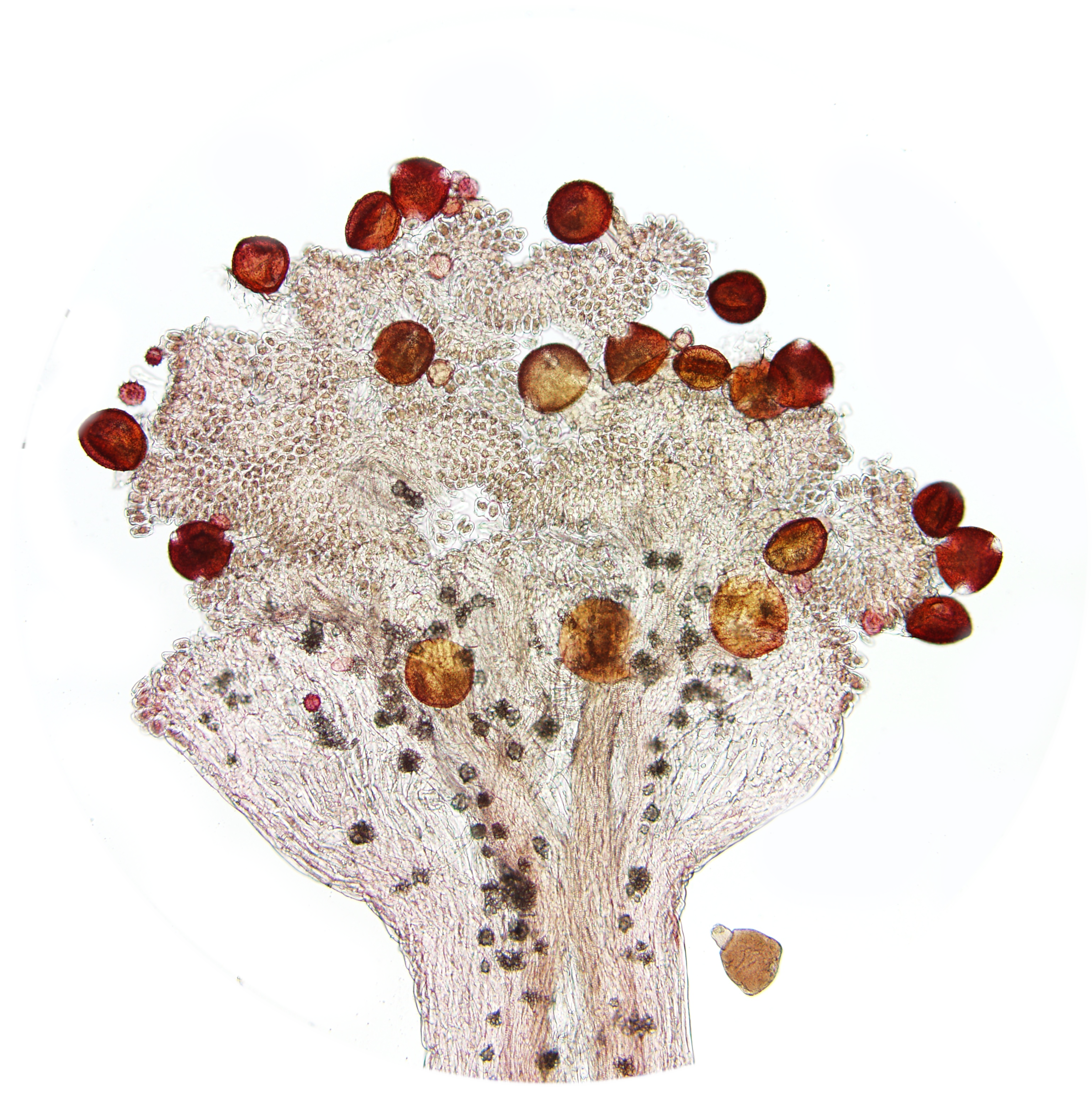
Within the network of relationships, we are not only interested in how pollinators visit plants, but also how this leads to pollen transfer between plants. Since most plants share their pollinators with other plant species, it is interesting to observe how pollen transfer between plants manifests itself: is it completely equivalent to how pollinators visit plants, or are there some plants that transfer their pollen to other plants more often than we might expect based on the visitation network? Which plants are they?
As part of this experiment, we will collect stigmas on which we will later identify the transferred pollen in the laboratory.
Forks (Vidle)
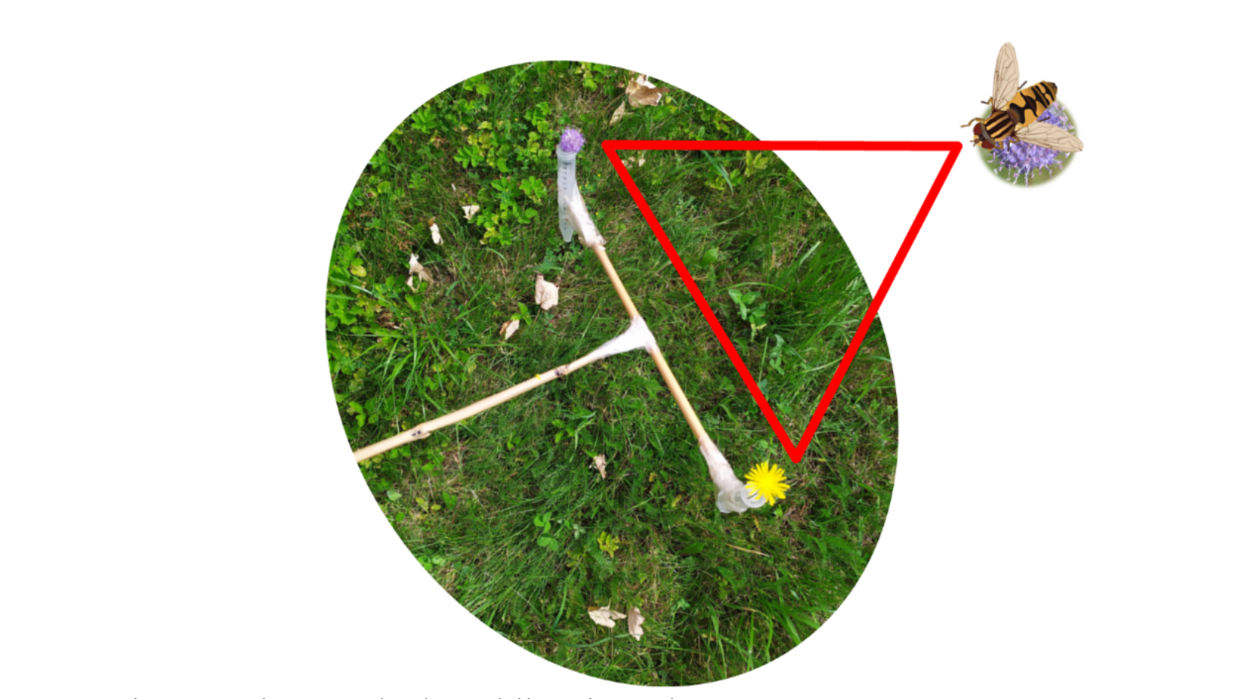
Within the relationships between pollinators and plants, it is interesting to observe how pollinators decide which flower they prefer to fly to. But to screen out the influence of plant distribution in space, we always offer pollinators two flowers on a long stick with two vials with water and flowers. We call this tool “forks”. Then it suffices to offer two flowers to a pollinator on a flower and record which flower it decided on.
Trypanosomes
On our Handrkov meadow, we study trypanosomes and other parasites in the guts of hoverflies. We are primarily interested in which species of trypanosomes occur in the guts of pollinators and how pollinators pass them to each other. This part of the research is led by Šimon Zeman from the Department of Parasitology.
Artificial Flowers
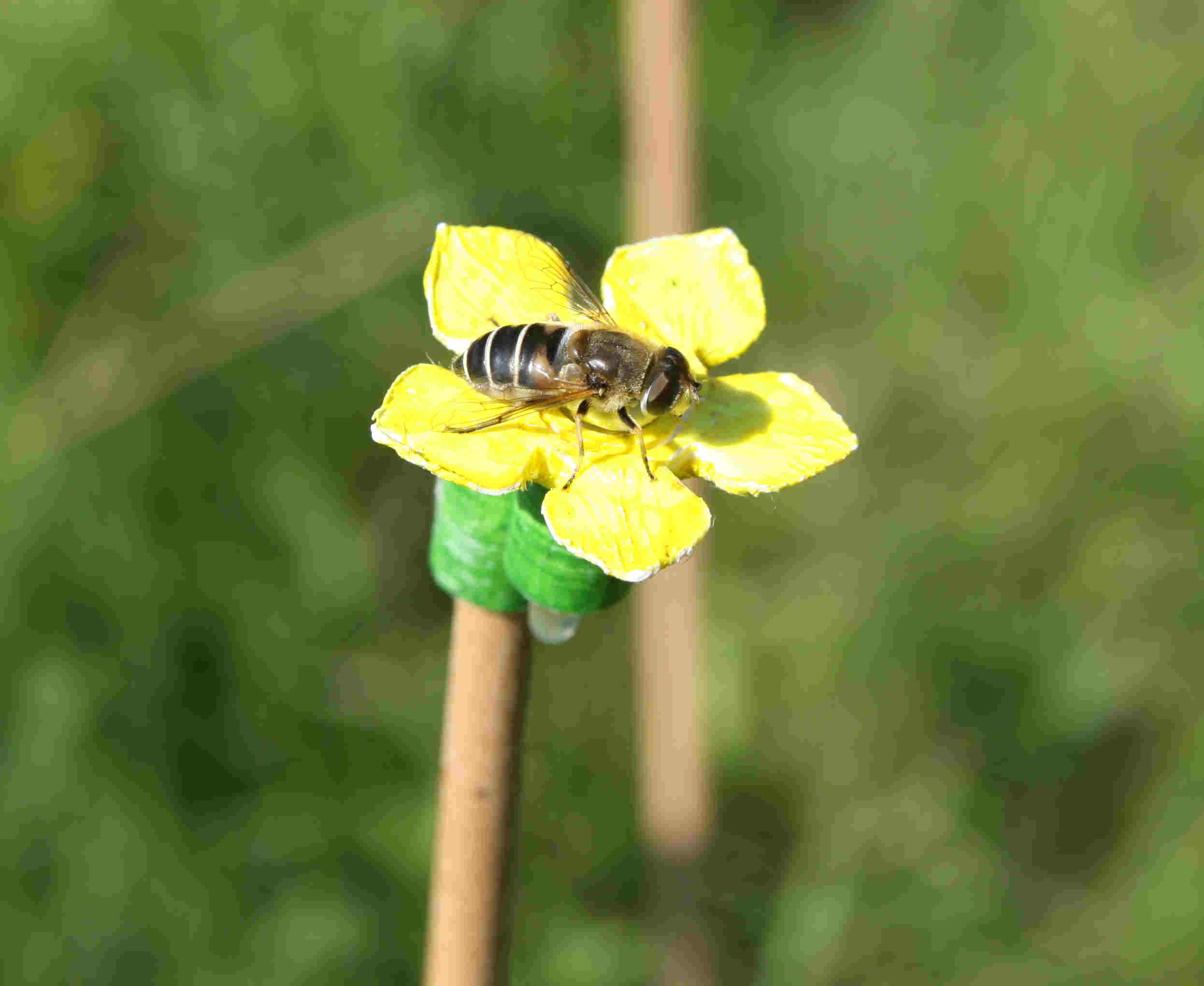
Within the preferences and behavior of pollinators, we are interested in which properties of flowers can change the decisions of pollinators and potentially which properties are more important than others. Is it color? Size? Or shape? But it can also be the position of the flower within the inflorescence or even the height of the flower. To better understand pollinators and their moods, we use artificial flowers, on which we can practically manipulate their appearance and thus observe which properties influence pollinators. This year we will continue with these experiments and see what results they bring.
Nocturnal Pollinators
This year we plan to try a new methodology for observing nocturnal pollinators, both by shining light on a screen and by walking around the meadow with a red headlamp and recording using night vision cameras. We will see how it works out!
Further Reading about Pollinator Research at Handrkov
Relationship between plants and pollinators in the meadow (Article in Živa magazine - CZ)